
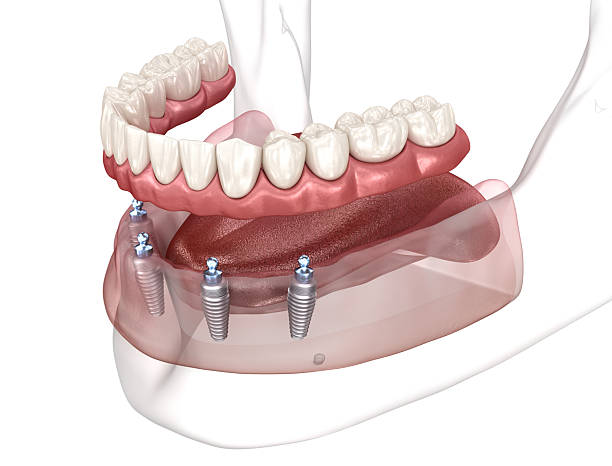
Choosing All-on-4 vs. All-on-6 comes down to how many implants support your new teeth and where they sit. Both are full-arch tooth replacement approaches that use four or six dental implants to support a complete set of fixed teeth.
Six implants are not automatically better than four. The right choice depends on implant distribution, jaw anatomy, available bone, the design of the final teeth, and your health and bite. Six poorly positioned implants do not guarantee better support than four well-placed ones.
This guide explains how implant number affects stability, bone needs, upper and lower jaw planning, and cost. It also shows how patients in Raleigh can evaluate full-arch options with an implant dentist.
What Is the Difference Between All-on-4 and All-on-6 Dental Implants?
All-on-4 supports a full arch of teeth on four implants, while All-on-6 uses six. Both replace an entire upper or lower arch with a single implant-supported bridge. The differences lie in how support is spread across the jaw and how much bone each design needs.
| Factor | All-on-4 | All-on-6 |
|---|---|---|
| Implant Count | Four per arch | Six per arch |
| Implant Distribution | Two front implants, two rear implants often tilted | Six implants spread along the arch, angled as anatomy requires |
| Bone Requirements | Can work with limited bone in the back of the jaw in selected cases | Needs suitable bone at more sites |
| Prosthetic Support | Four support points | Six support points |
| Surgical Considerations | Fewer implant sites; angled placement needs precise planning | More implant sites to plan and place |
| Maintenance | Daily cleaning plus professional visits | Daily cleaning plus professional visits |
| Cost | Set by the full treatment plan | Set by the full treatment plan |
How All-on-4 Uses Four Implants to Support a Full Arch of Teeth
In a typical All-on-4 design, two implants sit toward the front of the jaw. Two more sit farther back, and they are often tilted. Tilting lets the rear implants be longer and anchor in denser bone farther forward, while avoiding structures like the sinus or a nerve.
The tilt also moves the rear support point farther back. That can shorten the part of the bridge that extends past the last implant. Exact angles and positions always depend on your anatomy and the treatment plan.
How All-on-6 Uses Six Implants to Support a Full-Arch Restoration
All-on-6 adds two more support points along the arch. Six implants can share chewing forces among more anchors and may give the restorative team more design flexibility.
The six implants do not have to sit in a fixed pattern or stand parallel. Some may be angled to fit the available bone. What matters is that each implant sits where it can support the final bridge.
What Both Treatments Have in Common
Both approaches are forms of full arch dental implants that replace a whole arch with fixed, implant-supported teeth. Each requires 3D planning, careful surgery, a temporary phase, and a custom final bridge. Both also need daily cleaning and regular professional maintenance to stay healthy. You may also see the term All-on-X, which describes the same concept with an implant number tailored to each patient.
How Does Implant Number Affect Full-Arch Stability and Bite Forces?
Implant number affects how chewing forces travel from the bridge into the jawbone. But position, spacing, and bridge design shape that force path just as much as the count.
Why Implant Position Can Matter as Much as Implant Number
Dentists often describe implant spacing as anterior-posterior spread, or A-P spread. It is measured straight back from the front-most implants to an imaginary line joining the back-most implants. A wider spread gives the bridge a broader, more stable base.
Six implants clustered near the front can offer less effective support than four implants spread well apart. Available bone, sinus and nerve positions, and the planned bridge all decide where implants can go.
How Chewing Forces Are Distributed Across Four or Six Implants
Every bite sends occlusal force through the teeth of the bridge into the implants and surrounding bone. In a full-arch design, the implants share this load through the rigid bridge connecting them. Chewing forces tend to be strongest toward the back of the mouth, which is why rear support matters.
With six implants, each one may carry a smaller share of that force. With four, careful positioning and bridge design help keep forces balanced. The restoration’s shape, materials, and bite pattern influence load sharing in both designs.
What Is a Cantilever in a Full-Arch Implant Bridge?
A cantilever is the part of the bridge that extends beyond the last supporting implant, often holding back teeth. It works like a diving board, with support on one end only.
A longer cantilever increases leverage on the rear implants and bridge components during chewing. That is why clinicians plan cantilever length carefully. Tilted rear implants in All-on-4, or extra rear implants in All-on-6, can both help shorten it.
Does All-on-6 Provide More Support Than All-on-4?
Sometimes, but not always. Six well-positioned implants may add support or design flexibility in some cases.
Research shows how conditional this answer is. A retrospective study in Clinical Implant Dentistry and Related Research followed 217 patients with immediate full-arch bridges for 3 to 13 years.
Overall, it found no significant difference in long-term results between four and six implants. For certain groups, including people who grind their teeth or have longer cantilevers or lower bone density, six implants performed more predictably in some clinical measurements.
How Do Jawbone Density and Bone Volume Affect All-on-4 vs. All-on-6 Treatment?
Bone volume is how much bone is available, measured in height and width. Bone quality is how dense and firm that bone is. Both shape where implants can go and how many the jaw can support.
Why Available Jawbone Determines Where Implants Can Be Placed
Each implant needs enough bone around it to hold its length and diameter. After tooth loss, the jaw often shrinks, especially in long-term denture wearers. The sinus in the upper jaw and the nerve canal in the lower jaw also limit placement.
These limits decide which sites are usable. A jaw with suitable bone at six sites may support All-on-6, while bone at fewer sites may favor a four-implant design.
Why Bone Quality Matters for Initial Implant Stability
Primary stability is how firmly an implant is held by the bone at the moment it is placed. It comes from the mechanical grip between the implant and the surrounding bone.
Primary stability matters most when temporary teeth are attached soon after surgery. Denser bone can provide a firmer grip. Softer bone may call for different implant choices, more support points, or a modified loading plan.
Can All-on-4 Reduce the Need for Bone Grafting?
In selected cases, yes. Tilting the rear implants can let them engage available bone while avoiding the sinus or nerve. That may reduce the need for grafting in the back of the jaw.
It does not guarantee graft-free treatment. Bone loss in other areas, implant stability, and the planned bridge can still make grafting part of the plan.
When Might Six Implants Be Considered Despite Additional Bone Requirements?
Six implants may be considered when softer bone, heavy bite forces, or a long planned cantilever call for more support. They may also suit cases where the restorative design benefits from extra anchors. In these situations, a clinician may judge that grafting or careful site selection is worth it to reach six well-placed implants.
Is All-on-4 or All-on-6 Better for the Upper and Lower Jaw?
Neither option is automatically better for one jaw. The upper and lower jaws differ in bone density and anatomy, so each arch is planned on its own findings.
How Upper Jaw Bone Anatomy Influences Full-Arch Implant Planning
The upper jaw tends to have softer bone than the lower jaw, especially toward the back. The maxillary sinus sits above the upper back teeth. After tooth loss, the sinus can expand downward while the ridge shrinks, leaving little bone height.
These factors can lead clinicians to tilt rear implants, add support points, or plan a sinus lift. Softer bone may also make more implants worth considering for long-term support.
How Lower Jaw Anatomy Affects Implant Distribution
The lower jaw is often denser, particularly toward the front. The inferior alveolar nerve runs through the lower jaw and exits near the premolars. Implants must stay clear of it.
That nerve position can limit how far back implants go. Tilted implants or careful site selection help create enough spread without risking the nerve. Because the front of the lower jaw is often dense, implants placed between the nerve exits can provide solid support in suitable cases.
Why the Same Patient May Need Different Implant Configurations in Each Jaw
A patient replacing both arches may receive different plans for each one. For example, the lower arch might suit four implants while the upper arch needs six. Bone, anatomy, the opposing teeth, and bite forces are assessed separately for each jaw.
Can All-on-4 and All-on-6 Both Provide Fixed, Non-Removable Teeth?
Yes. Both configurations can support a fixed bridge that you do not take out at home. That differs from an implant overdenture, which snaps onto implants and is removed daily for cleaning. Whether teeth are fixed or removable is a separate decision from how many implants you have.
How a Fixed Full-Arch Implant Bridge Attaches to Dental Implants
Fixed full-arch bridges are typically screw-retained. Small screws secure the bridge to connectors on top of the implants. The screw access holes are then sealed with tooth-colored material.
You cannot remove the bridge yourself. Your dental team can unscrew it when needed for professional cleaning, inspection, or repair.
Temporary Teeth vs. Final Full-Arch Implant Restorations
Full-arch treatment usually has two phases. First, you wear a temporary bridge while the implants bond with the bone. At Carolina Implant, patients wear a temporary prosthesis during this healing period. A softer diet during this phase helps protect the healing implants.
Temporary teeth do not mean healing is complete. They are built for lighter use and designed to protect the implants while bone integrates. The final bridge is made once the implants are stable and your bite and appearance have been refined.
How Prosthetic Materials Affect Full-Arch Treatment
Full-arch bridges are made from several material types. Common options include acrylic teeth on a supporting framework, composite resins, and zirconia-based designs. Materials differ in weight, strength, wear, repairability, and appearance. Your restorative team will recommend a material based on your bite, opposing teeth, and goals.
How Do All-on-4 and All-on-6 Compare in Treatment Time, Recovery, and Cost?
Surgery, healing, bridge fabrication, and cost each depend on more than implant count. Here is how the two designs compare in each area.
Does Placing Six Implants Mean a Longer Surgery?
Placing two more implants adds steps, but implant count is only one factor. Surgical time also depends on extractions, bone grafting, implant angles, and whether both arches are treated. A complex four-implant case can take longer than a straightforward six-implant case.
Is Recovery Different With Four vs. Six Dental Implants?
Recovery follows similar principles for both. Expect swelling, soreness, a soft-food diet, and follow-up visits in the early weeks. Extractions and grafting can affect recovery as much as, or more than, two extra implants.
Two additional implants do not necessarily mean noticeably more discomfort. Your healing depends on the full scope of surgery and your overall health.
Is All-on-6 More Expensive Than All-on-4?
Two more implants and their components can raise the cost. But the total fee also reflects surgery, extractions, grafting, diagnostics, sedation, temporary teeth, and final bridge materials. The only reliable comparison is a written plan that itemizes your specific case. When comparing quotes, check whether each includes temporary teeth, the final bridge, and follow-up visits.
Does Implant Count Determine How Long a Full-Arch Restoration Lasts?
Implant count is only one piece. Longevity also depends on daily hygiene, professional maintenance, bite forces, grinding habits, bridge material wear, and your general health. A well-maintained arch on either design can serve you for years, while neglect can shorten the life of both. Regular professional visits let your team check screws, clean under the bridge, and catch wear early.
How Does a Raleigh Implant Dentist Decide Between All-on-4 and All-on-6?
The choice follows a clinical sequence, not a default. Each step narrows down which implant distribution will best support the teeth you need.
Reviewing Tooth Loss, Existing Dentures, and Patient Goals
The process starts with your situation. Your dentist will ask which teeth are missing or failing, how your current denture fits, and what you struggle to eat. You will also discuss whether you want fixed teeth and how you want your smile to look. Before implant configuration comes up, your dentist will confirm who qualifies for full arch dental implants.
Evaluating Bone Anatomy With Appropriate Imaging
3D imaging shows bone height, width, and shape across the arch. It also maps the sinus and the nerve canal. At Carolina Implant, 3D Cone Beam CT imaging and guided implant surgery support this planning. The scans reveal which sites can hold an implant and at what angle.
Assessing Bite Forces, Grinding, and Prosthetic Space
Strong bite forces and grinding, called bruxism, place extra stress on implants and bridges. Opposing natural teeth or a fixed bridge can also create higher forces than an opposing denture. Your dentist will measure restorative space, the room available for the bridge between your jaws. Each factor can shift the recommendation toward more support. Patients who grind may be advised to wear a night guard to protect the bridge.
Choosing an Implant Distribution That Supports the Final Restoration
Full-arch planning works best when it starts with the final teeth. Your team first designs where the teeth should sit, then chooses implant positions that can support them. The number of implants follows from that design, your bone, and your bite. This restoration-led approach keeps the focus on how your new teeth will look, function, and be cleaned, rather than on a number.
Frequently Asked Questions About All-on-4 vs. All-on-6
Is All-on-6 stronger than All-on-4?
Not automatically. Six implants add support points, but strength depends on how well the implants are spread, the quality of the bone, the cantilever length, and the bridge design. Four well-positioned implants can provide stable support for a full arch. Your dentist weighs bone, bite forces, and grinding habits to decide which design suits you.
Do six dental implants last longer than four?
Implant count alone does not decide how long a full-arch restoration lasts. Longevity depends on daily hygiene, professional maintenance, bite forces, grinding, bridge materials, and overall health. One long-term study found similar results overall. Six implants performed more predictably in some measurements for certain groups, such as people who grind their teeth.
Can All-on-4 implants support permanent teeth?
Yes. All-on-4 implants can support a fixed bridge that only your dental team can remove. After a temporary phase, the final bridge is attached once the implants are stable. Like any restoration, it still needs daily cleaning, regular maintenance, and occasional repairs over time.
Is All-on-6 better for the upper jaw?
Not as a rule. The upper jaw tends to have softer bone, and the sinus can limit rear implant sites, which sometimes favors extra support. In other cases, tilted implants in an All-on-4 design work well. Bone density, sinus position, and bite forces in your upper jaw decide the plan.
Which option requires less bone grafting?
All-on-4 can reduce the need for grafting in selected cases, because tilted rear implants may avoid the sinus or nerve. All-on-6 needs suitable bone at more sites, which can sometimes require grafting. Your bone volume, its location, and the planned bridge determine whether grafting is needed for either design.
Can All-on-4 implants fail?
Yes, any dental implant can fail or develop complications. Risks include infection, inflammation around the implants, overload from grinding, smoking, and poor plaque control. Bridges can also chip or loosen. Careful planning, good hygiene, and regular professional checkups help lower these risks.
Can more implants be added to an existing All-on-4 restoration?
Sometimes. Adding implants depends on whether suitable bone exists in the right locations. The existing bridge may need to be modified or replaced to connect to new implants. Your dentist would evaluate imaging, bridge design, and the reason extra support is needed before recommending it.
How do I know how many implants I need for full-mouth tooth replacement?
A full evaluation answers this. Your dentist will review 3D imaging, bone volume and density, sinus and nerve positions, bite forces, and the design of your final teeth. Each arch is assessed separately, so you may need a different number of implants in your upper and lower jaws.
Explore All-on-4 and All-on-6 Dental Implant Options in Raleigh, NC
The right number of implants is not something to choose from a brochure. It comes from evaluating your bone, anatomy, bite, and the teeth you want to end up with.
At Carolina Implant, Dr. William Daily, DDS, DABOI/ID, and our team plan full-arch treatment with 3D Cone Beam CT imaging, guided surgery, and an on-site lab. Patients from Raleigh, Cary, Wake Forest, and across the Triangle can schedule a free consultation or call our new patient line at (919) 823-3015. We will review your imaging, explain whether four or six implants suit each arch, and answer your questions.